
How Can You Be Haunted By Something You Can’t Remember?
Memory tends to be thought of as something straight forward and linear, like a camcorder capturing life as it happens. But the process of how our brain goes about encoding each experience we encounter is a web still being unwound. In the case of traumatic memory, this only rings more true. Trauma, unlike non-traumatic memory, is often stored in fragments. During the event, the prefrontal cortex goes “offline”. In place of a traditional narrative consisting of a beginning, middle and end, the limbic system latches onto different sensory input (information that will often later act as triggers). It’s this fact that sits at the core of a notion growing increasingly more embraced, first by the psychology field and now by the general public: The body remembers trauma.
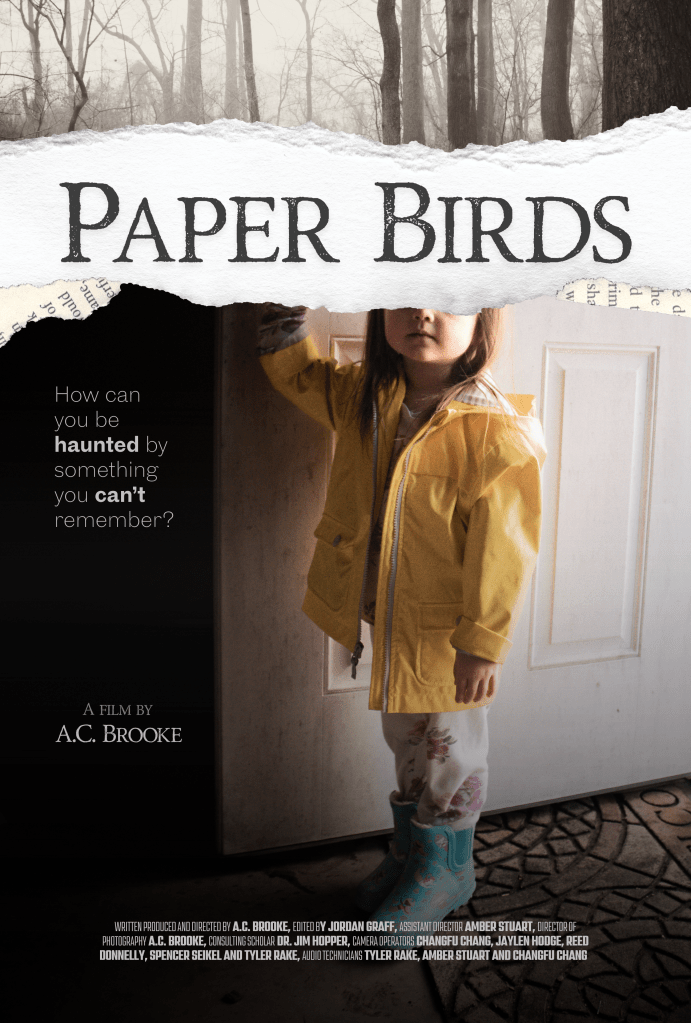
Paper Birds is a short documentary illuminating what it’s like to live with what you can’t remember in the conventional sense, and–more importantly–demonstrates that healing is possible even in the absence of answers. Following my own story, this piece presents a complex, misunderstood facet of trauma through interviews, reenactments and symbolic b-roll in a way that can be easily digested by the general public. The long standing stigma tied to recovered memories and the lack of media representation has, for far too long, discouraged survivors from talking openly about their experiences. Paper Birds stands to change that.
Watch the official trailer!
“There’s a deep rooted stigma tied to recovered memories that stops survivors from coming forward about their experiences, and further induces feelings of confusion and self-blame. Change starts with conversation, and conversation can only happen if we have the courage to speak up and share our stories.
A.C. Brooke | Director’s Statement
Want to say up-to-date with the project and get exclusive updates? Follow us!
You can keep up with Paper Birds on Instagram @projectpaperbirds. Or, sign up for our blog on our website, projectpaperbirds.com.
 A.C. Brooke